|
|
|
|
| Issue 74 | November 2026 |
| |
 |
| |
|
|
| |
|
In September, we talked about locking in your Daily Warm-Ups and Daily Routines. In October, we turned to small groups and independent work. This month, we’re adding the piece that makes all of it smarter: assessment. (Psst! These topics came up in questions during our recent Superkids Office Hours, too. Check out the Q&A report from that October 21 event.)
Assessment within Superkids isn’t a separate event that interrupts instructional time. Assessment turns everything you’re already noticing into data you can act on. Who needs another pass at short vowels? Who’s ready for a challenge? Which group should meet with you tomorrow, and what should you do when they get there? Your data answers those questions.
In this issue, we’re covering the assessments built into the program, how to fit them into a day that’s already full, how to read your online reports, and how to turn what you learn into a plan. Plus, you’ll snag a fun freebie for celebrating the growth your data reveals!
|
| |
|
|
|
|
| |
|
|
| |
|
Superkids is built for ongoing assessment, not occasional testing! That distinction matters—the growth of beginning reading skills happens irregularly, with pauses and leaps, and no single test on a single day can tell you where a student truly is. That’s why the program gives you multiple measures working together: formal tests at regular intervals, progress monitoring opportunities, the insights you get during Daily Warm-Ups, and the everyday reading and writing your students are already doing.
Your Assessment Books at a Glance
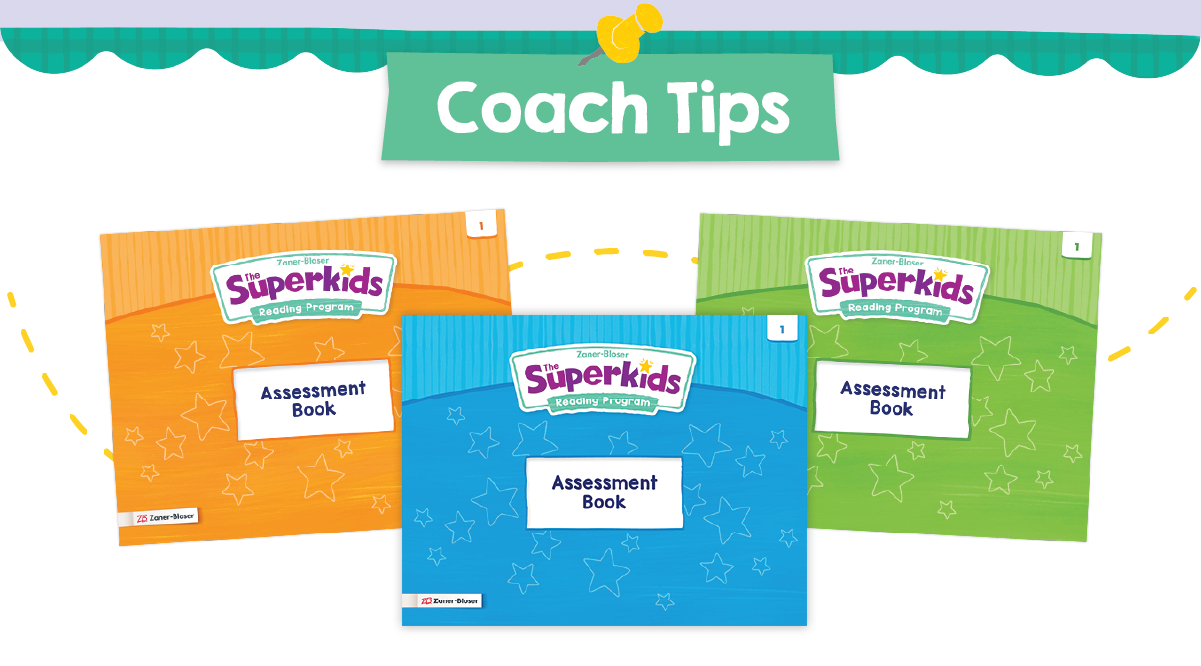
Each grade level has two Assessment Books—Book 1 covers the Warm-Up Unit through Unit 8, and Book 2 covers Units 9–17. Each Assessment Book is organized into three sections, and knowing what lives where saves you a lot of flipping.
⭐️ Formal Assessments
The Beginning-of-the-Year Test establishes each student’s baseline. Progress Tests are curriculum-based assessments that follow each unit and show how well students are mastering that unit’s objectives. The Midyear Test measures growth across the first half of the year and helps you gauge readiness for the second half, and the End-of-the-Year Test closes the loop. Each test comes with directions, reproducible student and teacher pages, answer keys, and—where writing is assessed—a writing rubric.
⭐️ Progress Monitoring
This section is the antidote to waiting for “the next big test.” It includes a Progress Monitoring Opportunities chart that maps each skill area to the everyday moments where you can observe it, plus writing rubrics for the end of each unit. In grades 1 and 2, you’ll also find fluency practice passages—unique passages that alternate between informational and literary text, each with a teacher recording sheet, a student version, and comprehension questions, administered one on one.
⭐️ Record Forms
This section includes reproducible Student Record Forms and Class Record Forms for the formal assessments, plus a Student Record Form for progress monitoring. Grade 2 also includes student and class Conferencing Forms for your one-on-one writing conversations. Formal assessment results can be recorded on paper or entered in the portal—whichever fits how you work best.
Ideas Worth Holding Onto
The assessment design in Superkids rests on a few research-based principles. They’re worth keeping in mind, because they explain why the program asks you to assess students the way it does.
⭐️ Ongoing Assessment
Occasional testing, no matter how regular, can’t capture a student’s progress on its own. Daily evidence fills in what the tests can’t see.
⭐️ Multiple Measures
Learning to read is a complex process and is rarely linear. No single tool can tell you where a difficulty lies or what to change in your instruction. Progress monitoring opportunities, formal tests, Daily Warm-Ups or Daily Routines, and everyday reading and writing each contribute a different piece of the puzzle.
⭐️ Integration with Instruction
Data is only useful when it’s analyzed to inform daily instruction. The Student Record Forms are designed to connect what you observe to the program’s objectives so you can adjust, and the reports in the portal are even more powerful for spotting trends and analyzing by student, student groups, or the whole class (scroll down for more on this👇).
⭐️ Professional Judgment
At the end of the day, you know your students in ways no score sheet ever will. That knowledge is a genuine qualitative measure, and it belongs in your interpretation of every result.
⭐️ Consistent and Immediate Feedback
Feedback is what makes an assessment worth taking. When students hear right away that a word was decoded correctly—or get a gentle correction before they move on—the learning lands while the attempt is still fresh. This matters most with foundational skills, because a misread vowel or a shaky letter-sound correspondence that goes unaddressed gets practiced, and practiced errors are far harder to undo than new skills are to teach. Quick, consistent feedback keeps small stumbles from settling in.
The throughline: when it comes to data, collect it, then use it! If assessment data collected on Friday never changes what you do on Monday, it isn’t earning its place in your week.
|
| |
|
|
|
|
|
|
| |
|
Let’s name a real barrier—assessment can feel like it’s competing with teaching. Every minute spent testing is a minute spent not instructing. That tension is genuine, and Superkids is designed to take this into account.
Here are five teacher-tested ways to make assessment fit in your literacy block.
|
|
1.
|
Progress monitor on a rotation.
Choose several students to observe every few days or once per week rather than trying to capture the whole class at once. Aim to record each student’s progress in at least one skill area every few weeks. In grades 1 and 2, biweekly fluency passages are often plenty.
|
|
2.
|
Assess inside what you’re already doing.
Your Daily Warm-Ups or Daily Routines are a prime informal assessment window—every student is participating, and you get a low-stakes read on who’s secure. Listening to daily oral reading and reviewing completed work count, too. The Progress Monitoring Opportunities Chart in your Assessment Book lists exactly which everyday activities give you a look at each skill area.
|
|
3.
|
Flex the tests.
The tests within Superkids are more adaptable than they look. You may administer a test in one session or spread it across several. If a portion of a test asks students to read text independently and that’s not where a student is yet, you may read the text aloud and provide support as needed. If you already collect and review student writing regularly in grades 1 and 2, you may choose to omit the writing portion of a formal assessment.
|
|
4.
|
Start the habit early.
When you begin jotting down notes during class early in the year, students eventually stop noticing. The clipboard becomes a standard instead of a spectacle and reduces test-related anxiety for students.
|
|
5.
|
Reach for Quick Assessments when you need a fast answer.
When you need to pinpoint a student’s strength or need in one specific skill, a Quick Assessment is a simple one-on-one task that takes very little time. In the © 2026 edition, you’ll find these in the Differentiated Instruction Teacher’s Guide. In the © 2017 edition, look on the back of the tabs in the Superkids Skill-Building Book.
|
| |
|
|
|
|
|
|
| |
|
A big payoff of administering assessments online is speed! Assessments completed digitally are scored automatically and results are delivered immediately, which shortens the distance between “tested” and “ready to use the data.” You’ll find your reports on the “Reports” page.
Here’s how to get the most out of the report views.
|
| |
 |
|
Whole-Class Data
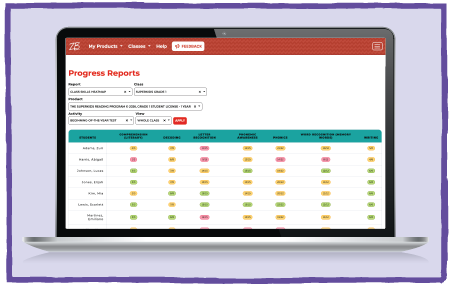
Once on the “Reports” page, navigate to “Progress Reports.” Under “Report,” select “class over time.” On this report, you’ll be able to see how many students were below level, on level, and above level on each progress test.
If you change the report to “whole class heatmap” and select an assessment, your class’s data will be presented as a grid. Read down a column to see how the whole class did on one skill. That vertical read is often underutilized—a column full of low scores may tell you something about instruction, not about all the individual students. That’s a signal to revisit a skill with the whole group.
|
| |
 |
|
Individual Student Data
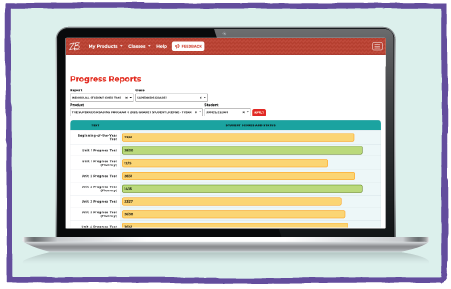
On the “Progress Report” page, change the “Report” drop-down menu to “Individual Student Over Time.” Look for consistent patterns across assessments rather than single misses. One low score could signal an off day, while a pattern demonstrates an opportunity.
|
| |
 |
|
Expand View
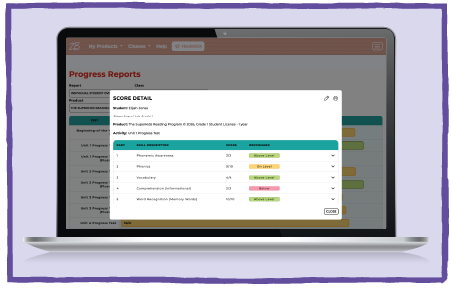
Want to know exactly what a test was measuring? From the view above, click on a composite score to see the specific objectives assessed in each section of a test. This is what turns “she struggled with part 3” into “she needs work on segmenting final phonemes.”
|
| |
 |
|
Drill Down Further
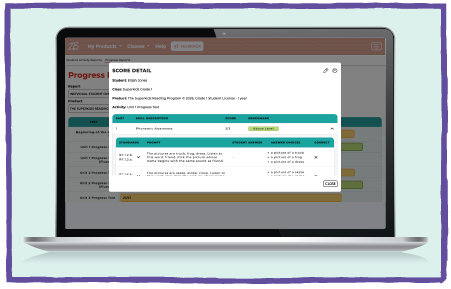
Next to each skill area in the view above, click on the drop-down arrow to see how a student actually responded to each question—not just whether the answer was right, but which answer they chose. It’s especially useful when a score doesn’t match what you’re observing in class.
|
| |
 |
|
Keep Tabs on Your Groups
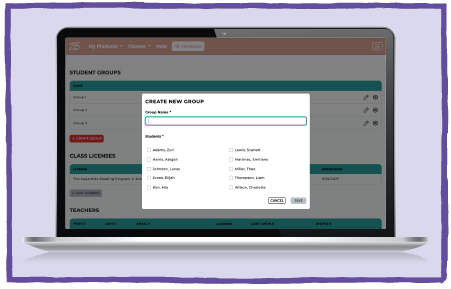
You can now sort your class into groups and filter many reports to show only a selected group of students! Click on “Classes” in the main navigation, then go to the “Overview” page. Scroll down to the “Student Groups” section to create and name your groups. Back on the “Progress Reports” page, you can then select your new groups in the “View” drop-down menu! This is a great way to check in on the progress of your small groups, a collection of students who need reinforcement on a particular skill, and more.
|
|
| |
|
✨ Scroll down to The Inside Scoop for more information on a new portal feature that makes fluency assessments easier than ever!
|
| |
|
|

• An insider look at the enhancements made to the new edition of Superkids •
|
 |
| |
|
|
|
|
| |
|
Like the © 2017 edition, the new edition of Superkids includes plenty of opportunities to monitor student progress. One improvement you'll notice right away is greater consistency across grade levels. Every grade includes three benchmark assessments: one at the beginning of the year, one in the middle, and one at the end. We recommend that all students complete these important checkpoints so you can track growth over time and measure progress from one benchmark to the next. In addition, shorter Progress Tests are available after every unit. These assessments can be given as needed, allowing you to gather information on specific skills and students without testing students on skills they've already mastered. The goal is a balanced approach that provides meaningful data while keeping assessment purposeful.
🗺️ Assessment Meets Adventure
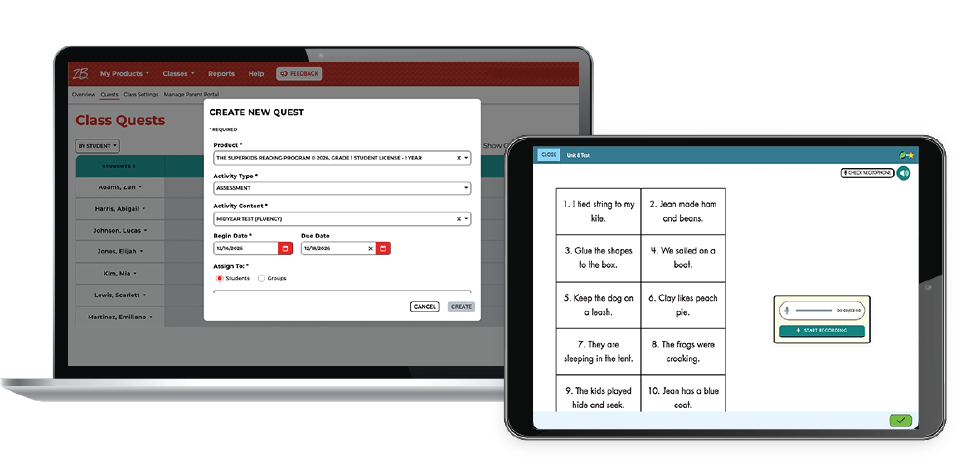
New and improved Quests are another exciting feature. Through the Teacher Portal, you can assign personalized combinations of formal and informal assessment activities, including formal tests, games, digital books, magazines, and videos. Quests can be assigned to individual students or groups of students, making it easy to tailor assessment experiences to specific learning needs. Best of all, Quests feel less like traditional testing and more like fun challenges that students can explore and complete on their own for badges and prizes within Superkids World. By blending assessment with dynamic activities, Quests help you gather valuable information while keeping students motivated and engaged!
🎙️ Fluency with Flexibility
Fluency assessments have been updated as well. Fluency checks for each unit are included in the Assessment Books for grades 1 and 2 and can also be incorporated into Quests. Teachers can listen to students read passages and score them in real time, or—new for the © 2026 edition—students can record themselves reading in Superkids World and submit those recordings for later review! This added flexibility allows you to collect meaningful fluency data in a way that works best for your classroom. It also helps maximize instructional time during the school day while giving you convenient options for reviewing and scoring assessments when it fits your schedule.
|
| |
| |
|
|
|
|
|
|
| |
|
Data doesn’t do anything on its own! Here’s how to turn what your reports and record forms are telling you into classroom decisions.
|
|
1.
|
Let the data build your small groups.
In the last issue, we talked about getting small groups up and running. Assessment should inform how you build your small groups. Use your formal results alongside what you observe daily to sort students by current strengths and needs—and then re-sort as new data is gathered! Be sure to update your groups in the portal as you adjust.
|
|
2.
|
Let the data set your pace.
If one skill is low across many students, that’s a pacing signal. Slow down and reinforce before moving on. Before you do, though, check the simplest explanation first: are the lesson parts and the reinforcement activities being taught fully? Sometimes a shaky skill signals a skipped step!
|
|
3.
|
Avoid over-reteaching.
The flip-side to the above—when only a few students missed something, resist the urge to reteach it to everyone. Pull a small group instead so that you don’t lose time the rest of the class needed for something else.
|
|
4.
|
Look at the whole picture, not just the score.
A composite score is one snapshot. Read across a student’s individual measures—a student can look fine overall while remaining genuinely stuck on one specific skill. That skill deserves targeted intervention.
|
|
5.
|
Use Midyear Test results for the bigger calls.
Your unit-level data guides the next two weeks. Your Midyear Test results guide the second half of the year. When those come in, that’s the moment to evaluate how well all students have performed across a multitude of skills over the first half of the year—and to make decisions regarding pacing, reteaching, and enrichment.
|
| |
|
|
|
|
|
|
| |
|
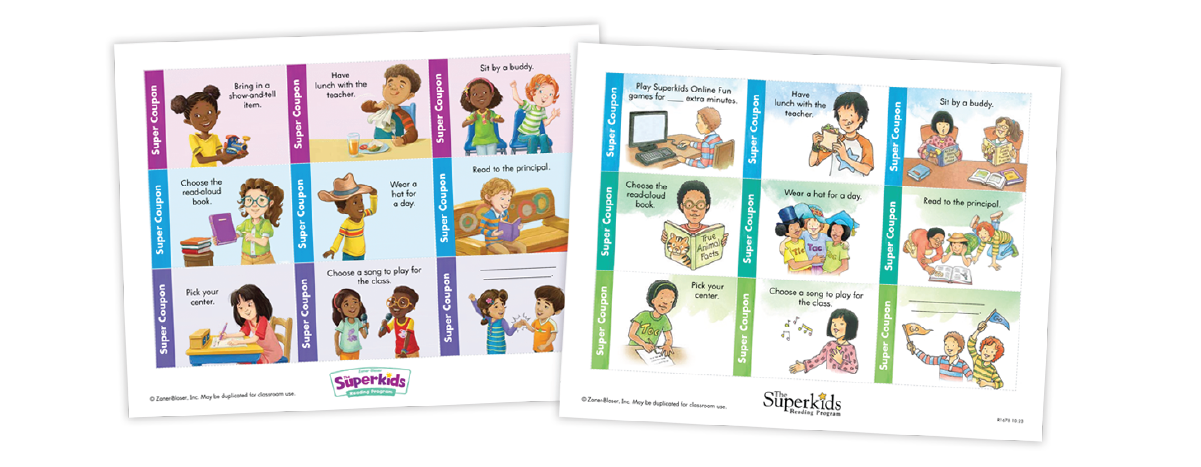
After all that assessing, noticing, and planning . . . celebrate! These printable Super Coupons are a set of reward coupons with positive, low-cost incentives your students will actually get excited about, plus a create-your-own option so you can tailor rewards to your classroom.
Here’s the part that can be easy to lose in a data conversation—your reports aren’t only showing you gaps. They’re showing you growth! A student who’s finally holding a vowel team steady, a group that succeeded on a task together, or a class column that’s greener than it was in September are wins worth naming out loud. Super coupons are a small, concrete way to hand a child the evidence that their hard work is paying off.
|
| |
|
|
| |
|
|
| |
|
Have an idea for this newsletter?
We’d love to share your tips, activities, and
inspiration with other Superkids teachers!
|
|
|
|
| |

|
| CR0076D |
|
|
|