Students’ Most Common Fractions Errors and What We Can Learn from Them

Fractions present challenges for many students, but fractions proficiency is required for success in advanced mathematics. Luckily, we know that struggle can be a productive step in learning. For example, we can examine the most common mistakes that students make with fractions to discover what they already know and what they have yet to learn.
Why Fractions Matter
Proficiency with rational numbers—including fractions, decimals, and percents—in elementary school is linked to later academic achievement in algebra and probability. The National Mathematics Advisory Panel notes that students must conceptually understand fractions, decimals, and percents; fluently add, subtract, multiply, and divide them; and accurately solve problems involving them.
Students may be able to fluently add, subtract, multiply, and divide rational numbers if they've memorized rote procedures, but procedural fluency alone does not indicate conceptual understanding. The key to understanding rational numbers conceptually is the ability to plot them on a number line. In fact, understanding a fraction’s magnitude and plotting the fraction correctly on a number line is predictive of the ability to accurately solve equations in algebra.
Why does success in algebra matter? Success in algebra and other types of advanced math often provides students with access to more college and career opportunities.
Beyond academic settings, research reveals that more than two-thirds of adults use fractions in their daily work—across industries and job titles! Fractions are also applicable to everyday tasks such as cooking, financial management, time management, and health.
What Students Need to Know about Fractions
Research also identifies the subskills that support fractions understanding.
- Proportional Reasoning—the ability to compare quantities, sizes, and amounts
- Spatial Reasoning—the ability to make sense of space
- Magnitude Thinking—the ability to think about size or scale when making comparisons
Proportional reasoning allows students to see how one quantity changes in relation to another. This includes understanding that the ratio between two variables remains constant. If one quantity scales up or scales down, the other must scale by the same factor.
Spatial reasoning is the ability to mentally visualize, manipulate, and partition objects or lengths to understand numerical relationships. This includes mentally slicing a shape or line into equal segments and recognizing its value even if the shape is rotated or flipped.
Magnitude thinking enables students to perceive a fraction as a single number with a specific size and fixed location on a number line. This requires moving beyond fractions as “part of a whole” and visualizing them alongside integers on a continuous number line.
Most Common Fractions Errors
Let's examine the most common mistakes students make with fractions to identify which gaps they may have—and understand how to effectively support their learning.
Arbitrary Symbols
Students describe fractions as digits arbitrarily written above and below a dividing line and view fractions operations as unpredictable ways to manipulate those digits to produce answers. They have difficulty recognizing fractions as numbers that represent specific quantities.
Whole Number Thinking
Students mistakenly apply whole number reasoning to fractions, thinking larger numbers automatically mean larger fractions. For example, they say 3/8 is larger than 1/2 because 8 is larger than 2, or 5/13 is larger than 2/3 because 5 is larger than 2.
Whole number thinking also causes errors in fractions operations. For instance, students may expect multiplication to always make numbers larger, assuming 3 x 1/2 must be larger than 3.
Misunderstanding the Whole
Students equate the denominator with “how many pieces you have” instead of “how many equal parts in the whole.” When students don’t fully grasp the fact that parts must be equal, they may color three pieces out of five unequal parts and call it 3/5.
Misunderstanding what denominators represent is also problematic when adding and subtracting fractions. Given 1/4 + 1/4, students might simply add “straight across” and answer 2/8.
Understanding Fractions as Parts Only
Students envision all fractions as less than one whole, making 5/4 seem impossible. They may have difficulty converting a fraction greater than one to a mixed number and vice versa. They may treat mixed numbers as two separate values, seeing 1 and 1/4 but not able to locate 1 1/4 on a number line.
Overrelying on Visuals
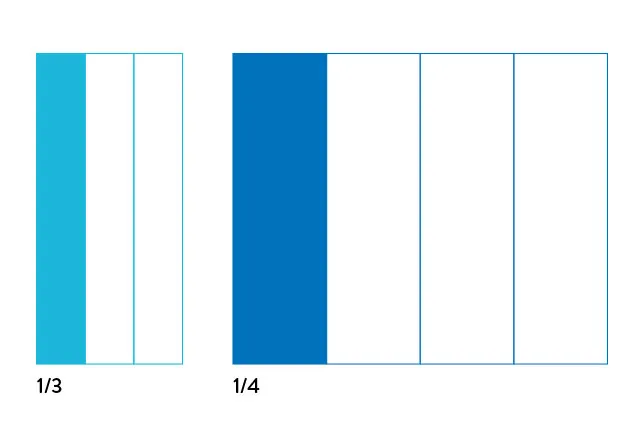
Students equate a fraction with a shaded shape rather than a number describing a relationship, so their reasoning becomes tied to how things look rather than what they mean. In this case, a student might see a skinny shaded region labeled 1/3 and a chunky shaded region labeled 1/4 and incorrectly conclude that 1/4 is bigger because it looks bigger.
Overcoming Common Errors
One reason fractions and proportional reasoning are tricky is that they require students to use concrete and abstract thinking skills simultaneously.
Many of the errors described above reflect limited understanding of the magnitude of rational numbers. That is why the National Mathematics Advisory Panel emphasizes number line activities that involve plotting rational numbers and whole numbers to better understand their size and relation to each other. Even the errors caused by overgeneralizing properties of whole numbers to fractions could be reduced by more work with number lines because this visualization helps students learn that every number—whole or rational—has a single and specific value.
Strong conceptual understanding of what a fraction represents will also eliminate some of those common errors. Students must recognize a fraction as part of a whole and internalize the significance of equal parts of a whole. Hands-on experiences with pattern blocks, number lines, collections, and measurement can help solidify students' ability to visualize equal parts of a whole.
Once students have strong conceptual understanding of what a fraction is, they can explore fractions operations in meaningful ways. In contrast, when rote procedures and algorithms are emphasized, students tend to become confused, unsure which procedures to use in which circumstances.
Lastly, research underscores that students must become fluent in their ability to apply fraction knowledge to fraction arithmetic and word problems. Word problems that help students connect the math they’re doing to their daily real-world experiences are critical.
Intervention Pays Off
Fortunately, intervention makes a difference for students struggling to access their core math curriculum and meet grade-level expectations. Targeted interventions aimed at building students’ sense of fractions and strong conceptual understanding of fractions as numbers with values are particularly beneficial.
Fourth-grade students who are at risk for failure with the advancing mathematics curriculum, due to histories of poor mathematics achievement in the primary grades, can succeed with challenging mathematics content, if they are provided with a well-designed intervention.
If you’re interested in targeted, research-informed small-group intervention for grades 3–5 fractions proficiency, explore Kickstart: Fractions or reach out to your Zaner-Bloser sales representative to learn more.
You May Also Like