
Marveling at Words: Joyful and Impactful Vocabulary Instruction for Young Children
Vocabulary knowledge is a significant predictor of comprehension and contributes to skilled reading and writing. In this white paper, Dr. Molly Ness examines the scientific research on vocabulary instruction for young children and offers ways to make vocabulary instruction engaging and effective using read-aloud books as a springboard.
Download as a PDF
A quick scan of popular picture books, such as Niko Draws a Feeling by Bob Raczka and Shark Lady: The True Story of How Eugenie Clark Became the Ocean’s Most Fearless Scientist by Jess Keating, demonstrates the treasure trove of vocabulary words to be found in children’s literature.
So much of K–2 children’s reading success depends on their ability to understand and use sophisticated words; of all of the substrands on the language comprehension portion of Hollis Scarborough’s (2001) Reading Rope, vocabulary knowledge has perhaps the most robust body of supporting research (National Reading Panel, 2000). However, we cannot underestimate the complexity of vocabulary as its daunting nature leaves many teachers and school leaders perplexed about the why, what, how, and when of explicit vocabulary instruction. In fact, research reviews revealed that much of vocabulary instruction is unsystematic and limited in its scope (Blanton & Moorman, 1990; Wright & Neuman, 2014).
Why Vocabulary Knowledge Matters
Vocabulary knowledge is a significant predictor of comprehension (Strasser & del Río, 2013). In their milestone 1997 study, Anne Cunningham and Keith Stanovich found that vocabulary knowledge in first grade predicted students’ reading achievement in middle and high school. Knowledge of word meanings supports students’ abilities to instantly recognize words (Kearns & Al Ghanem, 2019). Knowing a lot of words empowers readers to read more complex texts and to compose more sophisticated writing. A 2013 study of the National Assessment of Educational Progress (NAEP) reaffirmed the strong correlation between reading comprehension and vocabulary; students with higher vocabulary scores had higher overall reading comprehension in grades 4, 8, and 12.
Vocabulary, however, is not an isolated skill, but rather involves the integration of oral language, content-area instruction, morphemic analysis, interaction with and discussion of rich text, and general word appreciation (Fisher & Frey, 2014).

Reading researchers have conducted observational studies to better understand how vocabulary instruction occurs in primary classrooms. A 2013 study (Carlisle et al.) documented that vocabulary instruction only occurred in about 50% of literacy lessons. In their subsequent study, Tanya Wright and Susan Neuman (2014) observed over 600 hours of kindergarten instruction, finding generally impromptu and spontaneous vocabulary instruction. A three-year observational study of high-poverty K–3 classrooms (Nelson et al., 2015) indicated that teachers spent less than 5% of their language arts block on explicit vocabulary instruction, averaging only 7.55 minutes. Fortunately, a 2025 study by researchers Courtney Hattan and colleagues demonstrated an increase in vocabulary instruction.
The increase in quantity of vocabulary instruction must go hand in hand with its quality. For instance, studies showed teachers frequently asked students to define words, rather than first providing student-friendly definitions and inviting students to expand upon them, noting that, “it is possible that hearing multiple inaccurate definitions from classmates might enhance or reinforce students’ misunderstandings about words” (Hattan et al., 2025, p. 15).
When instructional materials and teachers provide student-friendly definitions with opportunities for students to expand on them, we engage students in rich oral language, make vocabulary interesting and relevant to them, and maximize the potential of explicit instruction.
Repeated exposures to new words in oral contexts help contribute to all students’ understanding of new words, but especially for multilingual learners. These oral encounters can shift to written contexts as decoding and comprehension skills increase.
What Words Should Be Taught?
For many teachers, it is overwhelming to pinpoint a concrete number of words, as well as which words to teach. Reading researcher Scott Paris (2005) posited that vocabulary is an example of an unconstrained skill, one that is limitless and develops over an individual’s lifetime.
A 1984 study proposed that direct instruction covers 3,400 words per school year (Nagy & Anderson). Researchers Tanya Wright and Susan Neuman (2014) recommended 2–3 words per day, or about 11 words a week for young children.
To clarify the confusion over word selection, Isabel Beck and her colleagues (2013) offer a three-tiered approach. Children commonly learn Tier One words through everyday conversations and encounters without much effort. Tier Two words are sophisticated words that may label more basic ideas as well as the academic vocabulary words used across content areas, in a variety of texts. Finally, Tier Three words are the specialized, domain- and topic-specific words rarely used outside of content-area texts.
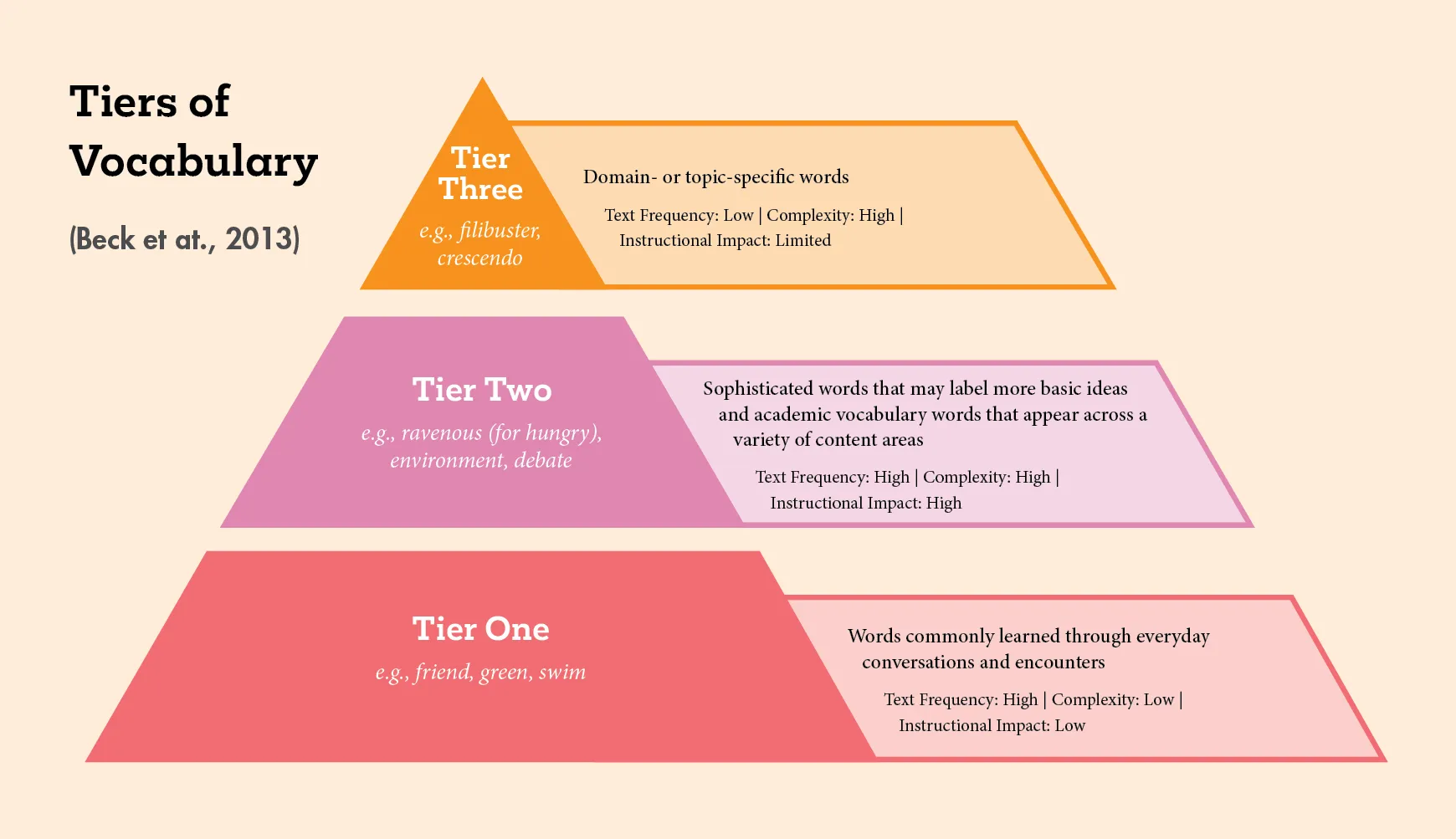
Note that multilingual learners who have not had much exposure to English vocabulary will need direct, explicit instruction to learn many Tier One words, unlike their English-speaking peers. These words are important for accessing text, navigating classroom conversations, and following directions thereby supporting overall learning and social interactions.
Considering the research of Isabel Beck, Elfrieda “Freddy” Hiebert, Michael Kamil, and William Nagy, the following reflective questions provide considerations for selecting appropriate vocabulary words:
- Is the word a high-value word, one that is repeated across a text or across a unit of instruction?
- Does the word have opportunities to transfer to students’ writing tasks, authentic conversations, and/or other classroom instruction? Would my students be interested in or motivated to use this word?
- Is the word essential to understanding a topic, text, or idea?
How Should Words Be Taught?
Direct, Explicit Instruction of Vocabulary
Just as intentional word selection is essential, so too is explicit instruction of vocabulary. According to the Florida Center for Reading Research (FCRR), explicit instruction is teacher-led, interactive instruction where the teacher’s actions and words are direct, clear, and unambiguous. Direct, explicit instruction of vocabulary entails providing clear definitions of the words that they will see in text; this is in contrast with learning words in isolation or not directly connected to texts.

In a first-grade classroom, explicit vocabulary instruction includes a student-friendly definition of the target word. That definition is short, simple, and straightforward; it’s particularly useful to use everyday language to connect the target word to what students already know. A first-grade example from Shark Lady might look like this:
What the Text Says
Eugenie was fascinated by sharks. She wanted to learn everything she could about these graceful creatures of the sea.
What the Teacher Says
When someone is fascinated, they can’t stop thinking about it. Eugenie was fascinated by sharks—she wanted to know all about them!
Furthermore, there is an efficiency to this direct instruction, as no time is lost on students inaccurately guessing the meaning of an ambiguous word or searching through overly complicated dictionary definitions.
More than Mere Definitions
Effective vocabulary instruction entails far more than providing students with a definition of the word; an individual knows a word if they can “recognize it, and use it, in novel contexts, and use knowledge of the word . . . to construct a meaning for a text” (Nagy & Scott, 2000, p. 463). In addition to knowing its definition, students benefit from examples and nonexamples of the word. They understand not only how the word is used in the focus text, but also how to apply the word to new, alternate contexts. Many students—particularly multilingual learners—benefit from images or pictures to reinforce the word meaning.
“A person who knows a word can recognize it, and use it, in novel contexts, and uses knowledge of the word, in combination with other types of knowledge, to construct a meaning for a text.”
— Nagy & Scott, 2000
So that students have multiple exposures and meaningful interactions with the word, teachers can facilitate rich conversation around target vocabulary. Here’s how those naturalistic, enriching vocabulary opportunities might look in a grade 1 classroom:
- "In our story, Eugenie was fascinated by sharks. Tell me/draw a picture of something that fascinates you."
- "What might you do if you were fascinated about a new thing?"
- "I’m going to give you a list of things. If they fascinate you, give me a thumbs up. If they don’t fascinate you, give me a thumbs down." [Teacher provides a list of topics (e.g., dinosaurs, rocks, butterflies).]
- “Watch my body. Tell me when I’m showing that I’m fascinated and when I’m not.” [First, teacher yawns and pretends to sleep, as students respond. Next, teacher shows wide eyes, smiling, leaning in, as students respond)."
- “Turn and talk with a neighbor, using my sentence stem. ‘I think ________ is fascinating because _______.’”
- “Let’s think of some words that mean the same as fascinated. Let’s think of some words that mean the opposite of fascinated.”
Other Effective Vocabulary Instructional Practices
Though highly impactful, direct and explicit instruction cannot cover students’ entire scope of words. Therefore, we must empower students with strategic knowledge to figure out unknown words. Through teacher modeling of word solving, students can become detectives using context clues and word parts (morphology) to determine a word’s meaning. A word of caution: while teaching how to use context clues helps, the overall effect on actual comprehension or vocabulary learning is sometimes modest (Kuhn & Stahl, 1998). We must be careful to model using strong context clues, as well as those that are nondirective or misdirective. In a first-grade classroom, we might use the following to model context clues:
What the Text Says
Eugenie wanted to discover the truth about sharks.
What the Teacher Says
Hmmmm….I’m not sure what the word discover means, but I think I have enough clues to figure it out. The author has already told me that Eugenie was really interested in sharks and that she wanted to learn everything she could about them. So here she wants to discover the truth about them. That lets me know discover means to find out something new.
Particularly as students encounter more complex text in upper grades, using word parts—prefixes, suffixes, roots, cognates, bases, and word families—is a strategic way for readers to use anything inside of the word to determine its meaning. (In all grades, cognates between English and a multilingual learner’s home language are useful to help learners understand new words.) In a first-grade classroom, teachers might demonstrate how basic morphology unlocks unfamiliar words in this way:
What the Text Says
The idea that sharks could be gentle was unbelievable to many people.
What the Teacher Says
Hmmmm….I’m not sure what the word unbelievable means, but maybe breaking it into its parts will help. I’ve seen un before, like in unhappy. I think it means not. If I feel unhappy, I feel not happy. I know the word believe. It’s kind of another way to say “think or feel.” So if I add up those little parts, I think the word is telling me that unbelievable is hard to believe. Maybe the sentence is saying that people couldn’t believe that sharks could be gentle.
When Should Vocabulary Be Taught?
Impactful vocabulary instruction must not be one and done. Students need multiple opportunities to say, see, write, use, hear, and apply the word. A 2011 study investigated how many repetitions of a new word preschoolers needed; only 20% of preschoolers could remember a word after hearing it three times. The majority of students (80%) could only remember the word after 24 repetitions (Pinkham et al.)!
Students should be motivated to use new words both across new contexts and for extended durations. In generalizing newly learned words beyond English language arts, students become more comfortable in the application of new words. For instance, students might be fascinated by a historical figure in social studies or seeds germinating in science—all examples of their new word across content areas. Students might embark on listening scavenger hunts for new words to earn points; they report back the times and instances in which they hear the word discover on television, in everyday conversation, from other adults, or in pop music. Our classrooms might include friendly competitions where students aim to “beat the teacher” in coming up with examples and nonexamples of things that are unbelievable. Our objective is for motivational ways for students to use new words multiple times across multiple days, thereby cementing that vocabulary in their lexicons.

Furthermore, our classroom discourse and instruction must be so engaging and stimulating that we can hardly satiate students’ eagerness for new words; the more enthralling our classrooms are, the more likely students will be to engage in wide reading, thereby propelling an upward trajectory in which children learn words, want more words, and seek out opportunities to learn more words. Mason and colleagues (2003) estimate that reading 60 minutes per day, five days a week, will result in learning 2,250 words per year—more than possible through direct instruction.
Joyful, Engaging Worlds of Words
It is tempting to tackle the complexities of vocabulary instruction with traditional workbooks or rote memorization of new words in isolation. These approaches, however, lack the joyful and engaging word play that emerges from using authentic literature as a springboard for effective vocabulary instruction.
Imagine classrooms where students are eager to share out topics that fascinate them! How might students’ conversations sound when they peruse for text evidence to demonstrate how a character was curious? How might we inspire children to read widely as we give them explicit and implicit exposure to sophisticated vocabulary? These are the promises and possibilities that come from harnessing the rich vocabulary words within our beloved children’s literature.
About the Author

She has extensive experience in reading clinics, consulting with school districts, leading professional development, and advising school systems on research-based reading instruction. She provides literacy leadership for nationally recognized literacy nonprofits, as well as major educational publishers. A frequent speaker and presenter, her happy place is translating the science of reading to schools and teachers. When she is not reading and writing about reading and writing, Dr. Ness is driving her ice-hockey obsessed teenage daughter to the rink, learning how to fly fish, or hiking with her poorly behaved goldendoodle.
References
Beck, I. L., McKeown, M. G., & Kucan, L. (2013). Bringing words to life: Robust vocabulary instruction (2nd ed.). New York, NY: Guilford Press.
Blanton, W. & Moorman, G. (1990). The presentation of reading lessons. Reading Research and Instruction, 29(3), 35–55. https://doi.org/10.1080/19388079009558015
Carlisle, J. F., Kelcey, B., & Berebitsky, D. (2013). Teachers’ support of students’ vocabulary learning during literacy instruction in high poverty elementary schools. American Educational Research Journal, 50(6), 1360–1391. https://doi.org/10.3102/0002831213492844
Cervetti, G. N., Fitzgerald, M. S., Hiebert, E. H., & Hebert, M. (2023). Meta-analysis examining the impact of vocabulary instruction on vocabulary knowledge and skill. Reading Psychology, 44(6), 672–709. https://doi.org/10.1080/02702711.2023.2179146
Cunningham, A. E., & Stanovich, K. E. (1997). Early reading acquisition and its relation to reading experience and ability 10 years later. Developmental Psychology, 33(6), 934–945. https://doi.org/10.1037/0012-1649.33.6.934
Fisher, D., & Frey, N. (2014). Content area vocabulary learning. The Reading Teacher, 67(8), 594–599. https://doi.org/10.1002/trtr.1258
Florida Center for Reading Research. (2023). Florida practice profiles: Explicit instruction. Retrieved from https://fcrr.org/educators/florida-practice-profiles
Hattan, C., MacPhee, D., & Zuiderveen, C. (2025). Vocabulary instruction during elementary classroom discourse: Observing 1st through 3rd grade teachers’ instructional practices. Literacy Research and Instruction, 1–27. https://doi.org/10.1080/19388071.2025.2457679
Kearns, D. M., & Al Ghanem, R. (2019). The role of semantic information in children’s word reading: Does meaning affect readers’ ability to say polysyllabic words aloud? Journal of Educational Psychology, 111(6), 933–956. https://doi.org/10.1037/edu0000316
Keating, J. (2017). Shark lady: The true story of how Eugenie Clark became the ocean’s most fearless scientist. Naperville, IL: Sourcebooks.
Kuhn, M. R., & Stahl, S. A. (1998). Teaching children to learn word meanings from context: A synthesis and some questions. Journal of Literacy Research, 30(1), 119–138. https://doi.org/10.1080/10862969809547983
Mason, J., Stahl, A., Au, K., & Herman, P. (2003). Reading: Children’s developing knowledge of words. In J. Flood, D. Lapp, J. R. Squire, & J. M. Jensen (Eds.), Handbook of research on teaching the English language arts (2nd ed., pp. 914–930). Mahwah, NJ: Lawrence Erlbaum Associates.
Nagy, W. E., & Anderson, R. C. (1984). How many words are there in printed school English? Reading Research Quarterly, 19(3), 304–330. https://doi.org/10.2307/747823
Nagy, W., & Scott, J. (2000). Vocabulary processes. In M. Kamil, P. Mosenthal, P. D. Pearson, & R. Barr (Eds.), Handbook of reading research (Vol. 3, pp. 269–284). Mahwah, NJ: Lawrence Erlbaum Associates.
National Assessment of Educational Progress. (2013). 2013 NAEP focus on vocabulary. Washington, DC: U.S. Department of Education, Institute of Education Sciences.
National Institute of Child Health and Human Development. (2000). Report of the national reading panel: Teaching children to read: An evidence-based assessment of the scientific research literature on reading and its implications for reading instruction. (NIH Publication No. 00-4769). Washington, DC: U.S. Government Printing Office.
Nelson, K. L., Dole, J. A., Hosp, J. L., & Hosp, M. K. (2015). Vocabulary instruction in K–3 low-income classrooms during a reading reform project. Reading Psychology, 36(2), 145–172. https://doi.org/10.1080/02702711.2013.839485
Paris, S. G. (2005). Reinterpreting the development of reading skills. Reading Research Quarterly, 40(2), 184–202. https://doi.org/10.1598/RRQ.40.2.3
Pinkham, A., Neuman, S., & Lillard, A. (2011). You can say that again! Preschoolers need repeated exposures to gain expressive vocabulary. Paper presented at the annual meeting of the Literacy Research Association, Jacksonville, FL.
Scarborough, H. S. (2001). Connecting early language and literacy to later reading (dis)abilities: Evidence, theory, and practice. In S. Neuman & D. Dickinson (Eds.), Handbook for research in early literacy (pp. 97–110). New York, NY: Guilford Press.
Strasser, K., & del Río, F. (2013). The role of vocabulary and working memory in children’s listening comprehension. Reading and Writing, 27(1), 387–402.
Wanzek, J. (2014). Building word knowledge: Opportunities for direct vocabulary instruction in general education for students with reading difficulties. Reading & Writing Quarterly, 30(2), 139–164. https://doi.org/10.1080/10573569.2013.843644
Wright, T. S., & Neuman, S. B. (2014). Paucity and disparity in kindergarten oral vocabulary instruction. Journal of Literacy Research, 46(3), 330–357. https://doi.org/10.1177/1086296X14551474