Why Math Teachers—and Their Students—Love Interactive Number Lines
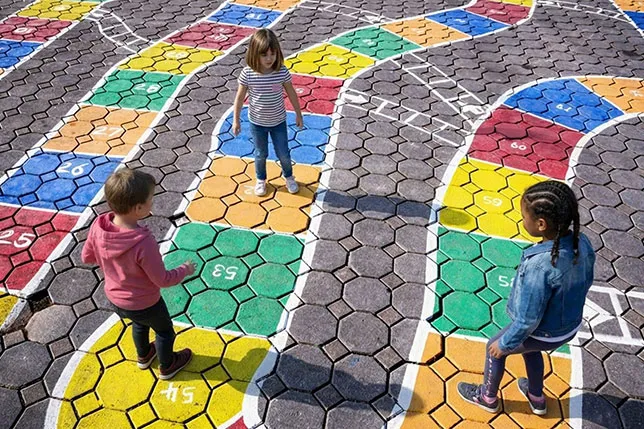
Number lines seem simple, but they're one of the most powerful tools in math education. They turn abstract ideas about numbers into visible, logical concepts.
The best part? Number lines don't have to stay on paper. In fact, some of the best learning happens when students get out of their seats to build, observe, and talk about number lines!
Why Teach With Number Lines
Number lines help students build strong number sense. They strengthen students' understanding of all kinds of numbers—whole numbers, fractions, decimals, and even negative numbers too.
With a number line, students can easily see key concepts:
- The order of numbers
- How big or small a number is
- Distance between numbers
- How numbers relate to each other
This understanding, in turn, helps students visualize numbers and quantities, take numbers apart and put them back together in different ways, compute mentally, connect numbers to real-life experiences, and talk comfortably about them.
Even when number lines are not specifically mentioned in math standards, they can be used as a model or tool to help students visualize required concepts.
How to Use Number Lines in Grades K–2
Young children may know how to count—perhaps even before they start school—but that doesn’t always mean they understand what numbers represent. That’s where number lines come in handy.
Number lines can inspire "aha" moments, enabling students to see connections between spoken numbers, written numerals, quantities, and spatial movement. Suddenly, math starts to click!
Start With Number Paths
In early grades, a slightly modified concept called a "number path" is preferred over a traditional number line. It is more concrete and, therefore, easier for students to comprehend. A number path is a horizontal line of equal-sized boxes. Students can count each physical box, matching a quantity with each printed numeral.
Once students understand that each number on the path represents a specific quantity, they can move to a less literal, more representational number line. It is still helpful for the number line to contain only one tick mark per whole number—with nothing but blank space between whole numbers—because growing mathematicians are still inclined to count the tick marks. After grade 2, number lines that look more like rulers can help students begin thinking about the spaces between whole numbers.

Support Standards in Grades K–2
Specifically, number paths and simple number lines support understanding of several skills commonly seen in state standards for K–2:
- Counting and number-after knowledge (also known as counting on from a given number)
- Cardinality
- Comparison
- Estimation and Rounding
- Operations
Students see that numbers to the right are larger on a number line while numbers to the left are smaller, so they can compare numbers and "jump forward" to add or "jump backward" to subtract. Using a number line, students can see that 8 is closer to 10 than it is to 5, or that 11 is one more than 10, making concepts of estimating and rounding clear.
How to Use Number Lines in Grades 3–5
Number lines continue to be valuable in teaching grades 3–5 math. In fact, this may be where they are most important! Number lines make multiplication and division operations concrete. Additionally, the spaces between whole numbers on the line become the focus as students begin to work with fractions, including decimals and percents.
Support Standards in Grades 3–5
Specifically, number lines support understanding of several skills commonly seen in state standards for grades 3–5:
- Rounding whole numbers
- Elapsed time
- Fractions as numbers on a number line
- Equivalent fractions
- Comparing fractions
- Fractions operations
- Decimal notation
- Comparing decimals
- Decimal operations
For example, students can use a number line to divide the space between whole numbers into equal parts and locate a fraction between them. They can use number lines to prove fraction equivalence, showing that two different fractions, such as 1/2 and 2/4, occupy the exact same point on the line.
Students can compare fractions with different numerators and denominators by comparing their distances to benchmark numbers like 0, 1/2, or 1. They can even use number lines to show fractions as repeated jumps—multiplying 3 x 1/5 by modeling it as three consecutive jumps of 1/5 length starting from 0.
Are Number Lines a Research-Based Strategy?
Absolutely! Research proves the value of number lines in learning math.
- The National Council of Teachers of Mathematics (NCTM) emphasizes the role of math models such as number lines.
- The National Mathematics Advisory Panel identified the ability to locate fractions (including decimals and percents) on a number line as a key skill linking conceptual understanding and procedural fluency.
- Many studies show that a child's math achievement is highly correlated with how accurately they can estimate where a number sits on a line.
The act of building physical and visual number lines activates both the language and visual centers of the brain. This reduces cognitive load and embeds concepts into long-term memory.
How Do Number Lines Get Students Engaged and Excited About Math?
Number lines are excellent concrete learning tools and ideal opportunities for active student engagement! Engagement is crucial to nurture positive attitudes, motivation, and understanding in math. Active participation in hands-on, multimodal activities also improves retention and the ability to apply understanding.
In fact, if you only imagined two-dimensional number lines as you read this article, you're missing out on a lot of fun. Number lines that students see in their textbooks, math apps, or on the board at the front of the classroom—as well as those they draw themselves on paper or dry erase boards—are definitely useful tools and have tactile, hands-on qualities that support conceptual understanding. Our favorite number lines are ones that get students moving, talking, and thinking about math!
Classroom-Sized Number Lines
A giant number line that spans the length of the classroom invites physical activity and conceptual understanding. A kindergarten classroom, for example, might include a literal 1–20 number path on the floor stretching 20 feet in length. The number blocks comprising the path should be of equal size so the distance between numbers is always equal. Students can stand, walk, and jump on the path as they count, compare, add, and subtract numbers.
In grades 1–2, a 1–20 number path might be replaced by a 0–100 number line—still 20 feet in length—to support thinking about a larger scope of numbers. The numbers should still be equally spaced as a visual reminder of important number concepts. Students can still stand, walk, and jump on the path as they count, compare, add, and subtract. They can also skip count as an introduction to multiplication, experiencing it as rapid repeated addition.
In grades 2 and above, consider creating one or more large open number lines using colored tape on the floor or wall. Open number lines are blank lines without a defined beginning number, ending number, or predetermined points. They are flexible to fit any math problem. Having multiple open number lines in the classroom enables students to think together on them in small groups.
Human Number Lines
A teacher in Indiana shared a "human number line" activity with us after seeing it in a presentation by faculty from the University of Chicago STEM Education initiative at an NCTM Spring Conference. It is similar in concept to the giant classroom number line but invites students to do the thinking about placement and spacing of numbers.
The teacher created a large number line using painter's tape on the floor, marking 0 and 100 at the ends. Then she gave 10 students each a number and asked them to stand where appropriate on the line. They could not talk or show others their numbers. Students in seats discussed what numbers their friends might represent.
Next, students on the number line showed each other their numbers and rearranged themselves if needed. Students in seats also revised their guesses about each number. Finally, students on the number line revealed their numbers to all.
Used as a warm-up activity, the human number line provided opportunities to talk about estimating, simple fractions, distance, equality, and skip counting. Lots of different human number lines could be created on a giant open line marked by tape or ribbon in the classroom.
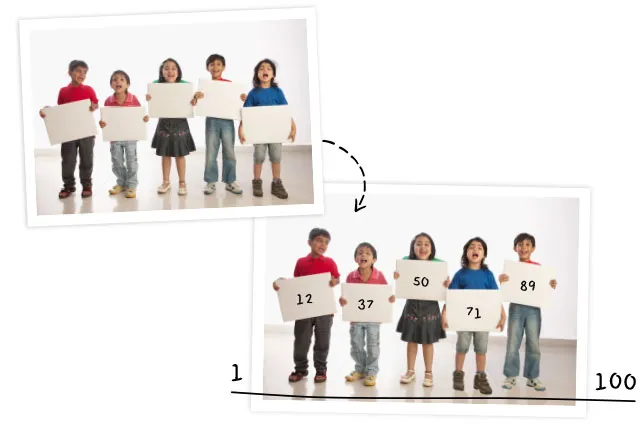
Interactive Clothesline Number Lines
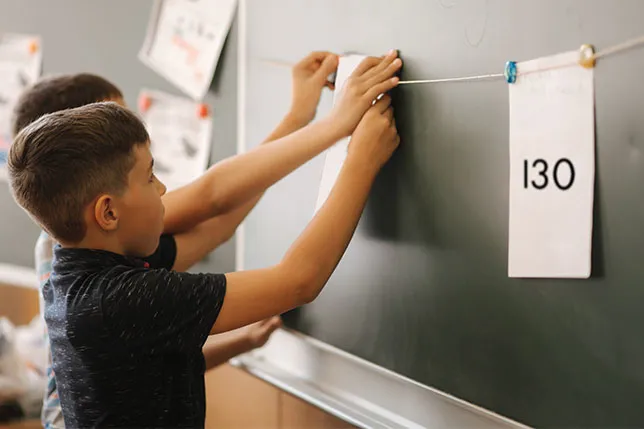
The phrase “clothesline math” has been used to describe the engaging activities and rich discussions that happen when a string displayed in the classroom becomes an open number line that students build by hanging number cards on it.
Using a set of cards with different representations of numbers printed on them, students can place and move the cards along the line. As new numbers or values are introduced, students can shift, compare, and re-evaluate card placement. This builds a flexible understanding of numbers in real time. These interactive number lines help students develop problem-solving skills and flexible math strategies—in whole-group instruction, small groups, or math stations.
Try Ready-to-Use Number Line Activities
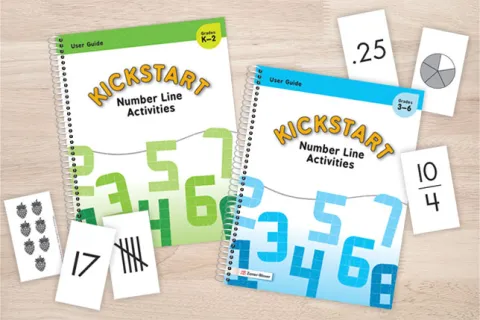
Kickstart: Number Line Activities is a set of collaborative, hands-on math challenges for students in grades K–6 using the clothesline math concept. Students visually and physically manipulate preprinted number cards or expressions in tasks designed to build number sense, foster mathematical reasoning, and encourage discussion about relationships between numbers.
Kickstart: Number Line Activities fits with any core math curriculum and arrives complete with a User Guide and Activity Cards. The K–2 set focuses on whole numbers through 100, and the grades 3–6 kit focuses on fractions and decimals. Download a sample activity to try in your classrooms.
You May Also Like