Language Comprehension: The Less-Talked-About Part of the Reading Rope

Word recognition skills including phonics and decoding get a lot of attention in conversations about the science of reading. These are undeniably important skills that all students must be explicitly taught.
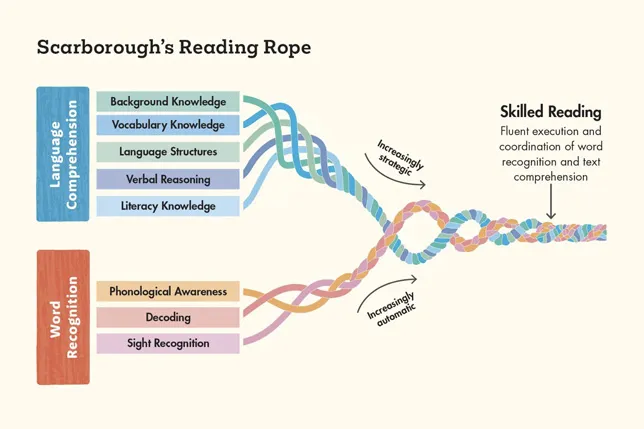
It’s also important to remember that what makes Scarborough’s Reading Rope an effective metaphor for skillful reading is the significant role all the strands play. Language comprehension skills are equally as important as word recognition skills. They’re interconnected and interdependent.
Perhaps language comprehension skills get talked about less often because, frankly, teaching them is more difficult to prescribe. The subskills required for language comprehension don’t have a defined scope and sequence. Children don’t have to learn them in a specific order, and there’s really no limit to what we can learn and know about language. So what’s a teacher—or principal, curriculum director, reading coach, or parent—to do?
Language Comprehension Subskills
When we say language comprehension subskills, we’re talking about the skills at the top of Scarborough’s Reading Rope that ensure students can not only read texts but also understand them—whether reading independently or listening to a read-aloud.
Background Knowledge
Background knowledge, also sometimes called prior knowledge, refers to the broad body of information, experiences, and understanding a student possesses. It includes facts about specific topics as well as all the social, cultural, and linguistic things students know.
What a student holds as background knowledge varies hugely based on countless combinations of personal experiences—including their interests, geographic location, and family life.
Social knowledge, for example, includes knowing how to wait in line for a turn. Cultural knowledge includes knowing how people commonly greet one another (a handshake, bow, or kiss on the cheek). Linguistic knowledge includes knowing when formal language is more appropriate than casual language.
Vocabulary Knowledge
Vocabulary knowledge encompasses all the word meanings students know. It includes words students learned primarily through conversation, words they’ve encountered in real-world texts, and domain- or topic-specific vocabulary they’ve accumulated.
Language Structures
Language structures include semantics and syntax. Semantics involves precise and intentional word choice to affect meaning. Syntax includes word order and sentence structure as well as grammatical rules and conventions. In short, language structures enable students to understand nuance and know that where words are placed relative to other words and punctuation can change meaning.
Verbal Reasoning
Verbal reasoning refers to understanding figurative language as well as literal language. Metaphors, idioms, and tone of voice fall into this area—and require readers to understand inferred or implied meanings as well as literal ones.
Literacy Knowledge
Literacy knowledge encompasses everything a student knows about navigating a text. This includes knowing that we read from the top of a page to the bottom of it. . . that we read from left to right. . . what purpose a cover, front matter, table of contents, index, and appendix serve. . . how to recognize text structures such as problem and solution, cause and effect, compare and contrast, etc.
All five of these subskills—background knowledge, vocabulary, language structures, verbal reasoning, and literacy knowledge—combine to support language comprehension and make reading increasingly strategic.
Teach Language Comprehension Through Authentic Texts
Now that we’ve identified the subskills readers need to develop for language comprehension, let’s dive into how to teach them.
Reading researcher Dr. Molly Ness emphasizes the role that authentic texts play in teaching language comprehension. Authentic texts are written materials published in the real world and intended for purposes and audiences beyond the classroom—perhaps to entertain, inform, guide, document, or persuade.
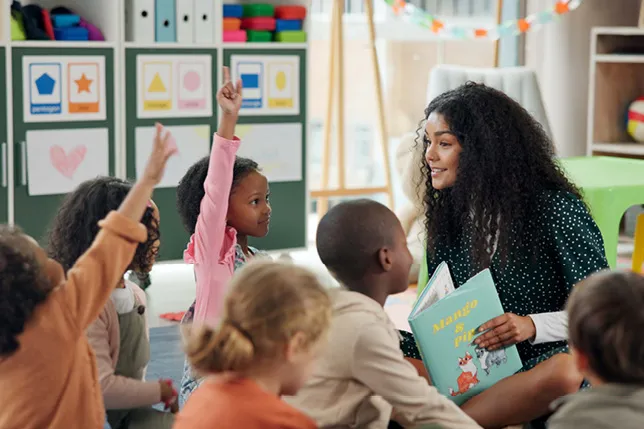
Although authentic texts are primarily written for life outside of the classroom, they happen to serve many purposes in the classroom too. Students and teachers frequently say read-alouds are a favorite part of the school day, and read-alouds typically feature authentic texts. The popularity of read-alouds combined with the rich content inside authentic texts presents ideal teaching moments.
As an added bonus, authentic texts are often readily available. Teachers can use not only the authentic texts included in their core reading program but also any they have in their classroom or school library collections.
Practical Strategies for the Classroom
Dr. Ness has shared several strategies with us for teaching language comprehension using authentic texts.
Put Read-Alouds to Work
One great thing about teacher-led read-alouds is that they allow students to focus on language comprehension without having to decode the text at the same time. This reduces cognitive load.
Teachers can talk about the book before, during, and after the read-aloud. Notice the same vocabulary word in multiple books, or explore multiple books with a common theme to develop background knowledge, for example.
Read-alouds can also include brief think-alouds where teachers model what readers do mentally as they read. For example, “That’s not what I expected him to say, but when I look at the illustration, I think I might know why . . .”
In this way, think-alouds can demonstrate inferring, asking questions, clarifying meaning, and more!
Anticipate Struggles and Pre-Teach
Teachers can preview authentic texts to look for vocabulary that students might not know and then select a word to introduce before the read-aloud.
For example, in Knuffle Bunny, a picture book by Mo Willems, a beloved toy is left behind at the laundromat. Laundromat is a term that may be unfamiliar to many students. Before reading Knuffle Bunny aloud, the teacher might say, “Today we’re going to read a story that takes place in a laundromat. Raise your hand if you know what a laundromat is.”
The teacher might give a brief description in child-friendly terms and show some photos of laundromats. Then students will be able to imagine what’s happening when they hear the word in the story.
Dr. Ness reminds us that this single introduction to the word isn’t enough for students to truly learn it. Research indicates that we must encounter a word 12–15 times in context to remember it. Students can practice using the word in writing and conversation, spotting it in other texts, or even drawing pictures to illustrate its meaning. (See “Word-Curious Classrooms: Joyful and Practical Strategies for Teaching Vocabulary” for more.)
Play With Sentences
To strengthen language structure skills, students can practice putting the words of a cut-up sentence in the correct order. This provides an opportunity for them to notice and discuss how the placement of words can change their meaning.
Consider, for example, The boy hugs mom compared to Mom hugs the boy. Do these two sentences conjure up the same image in your mind?
Additionally, Dr. Ness notes that 70 percent of common three-letter, consonant-vowel-consonant (CVC) words have multiple meanings! It’s difficult to know what bat, box, or bug mean without the added context of a drawing or full sentence. Students will likely discover that ambiguity when they experiment with constructing sentences from given words.
Look Closely at Figurative Language
Develop verbal reasoning skills by showcasing an example of figurative language at the end of every morning meeting. Read the figurative language aloud and model how you might make sense of it.
For example, “The supermarket was a zoo. Wait, that doesn’t seem possible. What do I know about supermarkets? What do I know about zoos? Are there any ways they are alike . . .”
Teachers can use examples of figurative language that the class encounters in texts or hears in conversation. Students will likely begin to bring in examples of their own as well. Consider building classroom dictionaries to document all of the figurative language the class encounters and discusses together.
Idioms, a type of figurative language, tend to be culturally specific, so they can be especially challenging for multilingual learners. Teachers can pre-teach the meaning of an idiom before students hear it in a read-aloud—in the same way challenging vocabulary words are introduced in advance of a read-aloud and reinforced afterwards with additional activities.

Built-in Language Comprehension Instruction
The Superkids Reading Program incorporates evidence-based reading practices and fun-filled experiences like those described above into a comprehensive English language arts curriculum that teaches all subskills of the Reading Rope. Superkids is designed to instill confidence and nurture curiosity in K–2 readers.
- Read-alouds of authentic texts include built-in modeling and discussion routines that develop language comprehension subskills.
- Big Topics help students connect what they may already know with new information and deepen their background knowledge over time.
- Daily guided discussion and writing activities help move students from simply understanding vocabulary words to using them independently.
Learn more about Superkids instruction by exploring the website or reach out to your sales consultant for more information.
You May Also Like