Word-Curious Classrooms: Joyful and Practical Strategies for Teaching Vocabulary

The ability to recognize, understand, and effectively use a large number and variety of words is key to success as a reader, writer, listener, and speaker. Increasing a child’s vocabulary is not simple, but a playful sense of curiosity and joy for words makes learning vocabulary natural and fun—with lasting results!
Why Vocabulary Instruction Matters
Vocabulary knowledge has a lasting impact. Research tells us that a strong vocabulary in first grade is linked to higher reading achievement in middle school and high school. The benefits aren't limited to reading fluency and comprehension. A rich vocabulary enables students to read and write more complex texts. When students recognize and produce words quickly and automatically, they can engage more deeply with ideas.
The science of reading confirms the importance of vocabulary. Vocabulary is one of the strands that strengthens language comprehension skills in the theoretical model known as Scarborough’s Reading Rope. Because vocabulary is one of the most researched subskills of the rope, scientists have uncovered a lot of insight about how best to teach it.
What Vocabulary Words to Teach
Vocabulary has been called an unconstrained skill—it is limitless and grows over a lifetime. That can make teaching it feel overwhelming. How many words should we teach? What words should we teach?
Researchers in the 1980s suggested that students learn 3,400 words per school year through direct instruction—or roughly 18 words per school day! Modern research revised that number to a more manageable 2–3 words per day. Notice, however, that this applies to direct, explicit teaching of the word. If students also read for 60 minutes per day, 5 days per week, it’s estimated they’ll learn an additional 2,250 words per year independently!
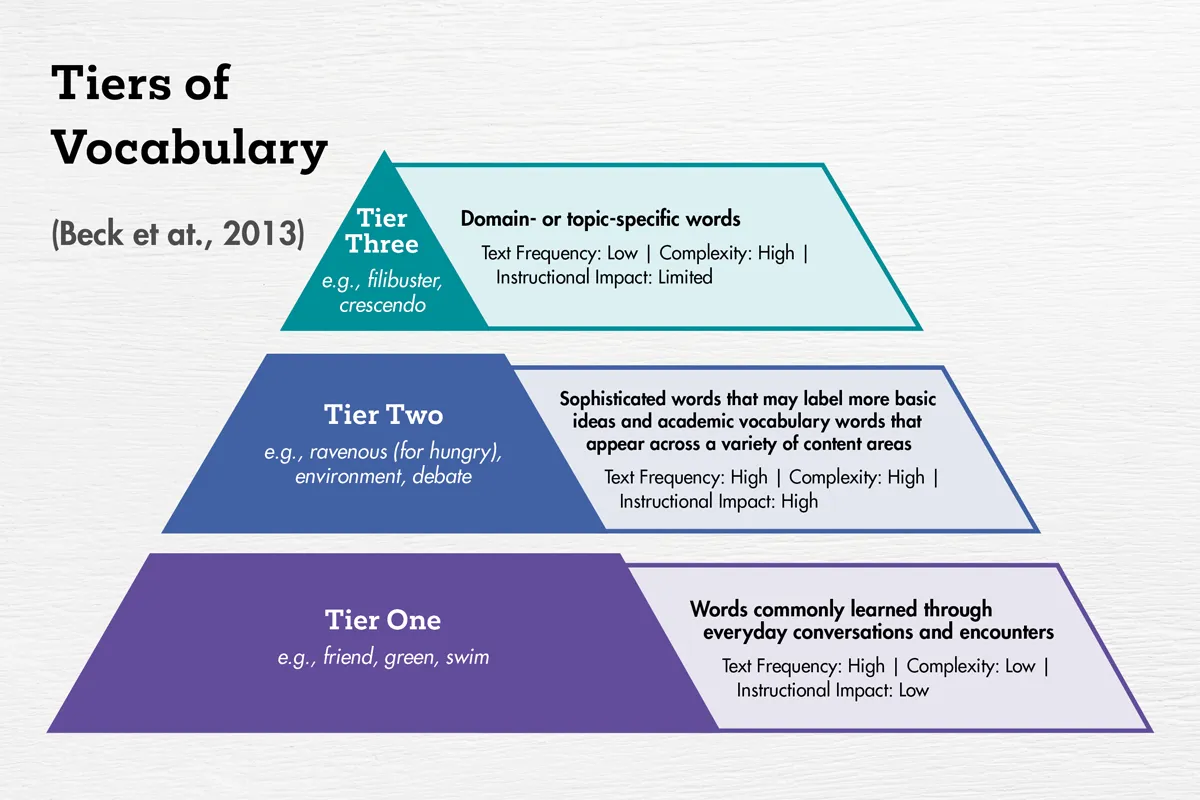
Research also helps us understand which words to teach. A framework developed by Drs. Isabel Beck and Margaret McKeown, co-authors of Zaner-Bloser’s Word Heroes, describes three tiers of vocabulary that guide decisions about what words to feature in direct instruction.
Tier One Vocabulary
Tier One includes words learned easily through day-to-day interaction and speech. Multilingual learners may need direct, explicit instruction to learn Tier One words while their English-speaking classmates do not.
Tier Two Vocabulary
Tier Two includes more complex words that appear often in texts across content areas. Words in this tier should be the primary focus of direct instruction in elementary classrooms because knowing these words has the most significant impact on academic achievement.
Tier Three Vocabulary
Tier Three includes words typically encountered in a specific field or subject matter. Because words in this tier help students understand a single topic, they are not usually the focus of direct instruction in a literacy block. They do not have a significant effect on reading and writing skills.
Other researchers building on Beck and McKeown’s work developed questions to help guide educators in selecting appropriate vocabulary words.
Is the word a high-value word, one that is repeated across a text or across a unit of instruction?
Does the word have opportunities to transfer to students’ writing tasks, authentic conversations, and/or other classroom instruction? Would my students be interested in or motivated to use this word?
Is the word essential to understanding a topic, text, or idea?
How to Teach Vocabulary Words
Once we know how many and which words to feature in direct instruction, we can consider how to teach them. Research emphasizes the need for direct, clear, and unambiguous instruction led by the teacher.
- Teach Words in Context, Connected to Texts
Words should never be taught in isolation. Instead, the teacher introduces a word just prior to students seeing it in print in real and natural use. This context provides additional support for understanding and remembering the word.
- Provide Student-Friendly Definitions
Before students see the vocabulary word in print, teachers should introduce the word, providing a short, simple, and straightforward definition in everyday language.
- Connect to Something Familiar
Connect the vocabulary word to something students already know or are familiar with to strengthen their understanding. You can provide a relatable example, synonym, or antonym.
- Reinforce Meaning with Images
Many students, including multilingual students learning English, benefit from seeing a picture that illustrates the meaning of the vocabulary word.
- Use the Word in Writing
Learning vocabulary isn’t simply memorizing a definition. Students must practice using the word in their own spoken and written sentences.
- Recognize the Word Elsewhere
Students should spot the vocabulary word in other speech or printed texts.
- Practice Frequently in Different Formats
Students need multiple opportunities to say, see, write, use, hear, and apply the word.
Inspire Word Curiosity
Vocabulary instruction fits quite easily into classrooms that value curiosity and authentic children’s literature. There are several ways to nurture a word-curious classroom.
Noticing interesting words during read-alouds is one way to build vocabulary and word curiosity simultaneously. If following the best practices described above for direct and explicit instruction, a teacher might introduce a vocabulary word before a read-aloud and then pause when it appears in the text and facilitate a brief discussion of it. There’s that word I told you about before we began. What does it mean?
Read-alouds also provide opportunities to model the thinking we want students to do when they encounter unfamiliar words in their independent reading. Hmm, I’m not sure I know what that word means, but I may have enough clues to figure it out. Or . . .maybe breaking the word into its parts will help. I’ve seen this prefix in other words. Multilingual learners might even consider other language clues. Do I know any words in my home language that look or sound like this English one?
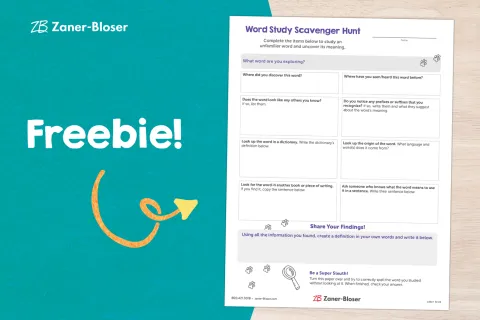
Teachers might offer enrichment activities that feature word play—crossword puzzles, word searches, creative writing exercises, and word-related board games, for example. Even the steps of explicit and direct vocabulary instruction can have a playful approach—perhaps a contest to see who can spot a new vocabulary word in the most places or invitations to draw a picture or act out a scene that illustrates the word’s meaning. You can even approach research of unfamiliar words in a playful way with a Word Study Scavenger Hunt.
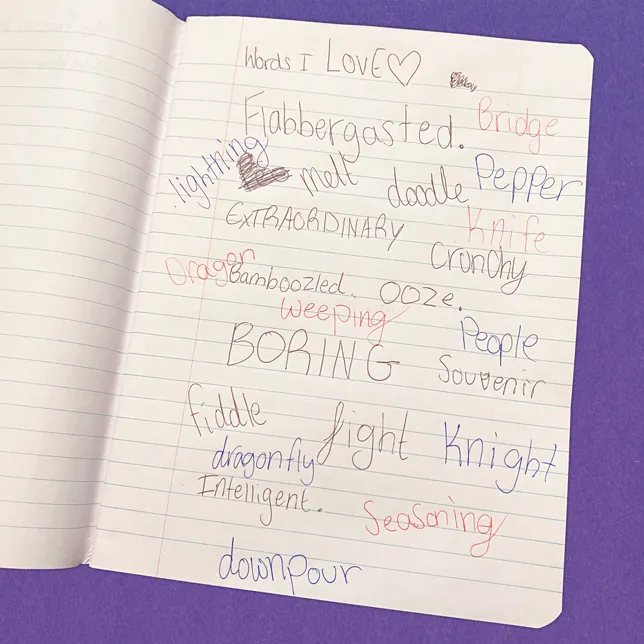
When we take time to notice the words that interest us, we build a culture of word curiosity and appreciation. Reading stories such as The Word Collector by Peter Reynolds, The Boy Who Loved Words by Roni Schotter, Donavan’s Word Jar by Monalisa Degrass, and The Keeper of Wild Words by Brooke Smith can deepen this work and serve as a springboard for ways your students might record the words that matter to them.
Creating Space for “Aha” Moments in Vocabulary
Zaner-Bloser programs embody both the science and joy of vocabulary learning. They are research based and aligned with the best practices in this article, featuring authentic, relatable children’s literature and playful activities.
The Superkids Reading Program, a core reading curriculum from Zaner-Bloser, teaches vocabulary in the context of read-alouds. A structured before, during, and after approach includes student-friendly definitions and active, playful practice with words in drawing, speaking, and singing activities as well as online games.
Word Heroes and Word Wisdom are built specifically to supplement curriculum when core instruction lacks playful and explicit vocabulary teaching.
Zaner-Bloser is also a member of the Highlights Family of Companies, a group that has always prioritized fun with a purpose. Highlights books and magazines indirectly support vocabulary building in playful contexts including word games and puzzles as well as stories, activities, crafts, and high-interest articles.
You May Also Like