Rockdale School District 84 Case Study: From Gaps to Growth

Need for Foundational Literacy Skills
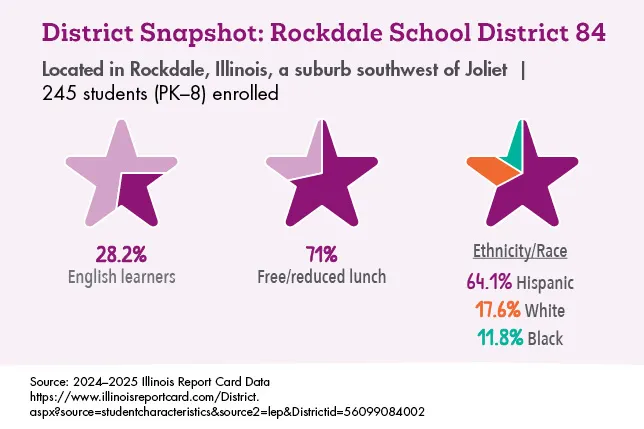
Rockdale School is a small, single-school district serving a population with a wide range of learning needs. When Principal Elizabeth Darlin arrived at Rockdale School District 84, the challenge felt immediate—and urgent—just 23% of students were reading on grade level.
More than three-quarters of students were having difficulty with foundational literacy skills, and the gaps were compounding by middle school.
From the beginning, Darlin understood that the change they needed was not a “wait-and-see” operation. “We knew that a lot of our middle schoolers were getting to sixth grade and couldn’t keep up with grade-level reading—they were just falling farther and farther behind.”
Darlin and her team knew incremental fixes wouldn’t be enough. They needed to rebuild literacy from the ground up, starting with the earliest grades.
A Reset for Early Reading Instruction
The team at Rockdale focused first on strengthening their Tier 1 literacy instruction, partnering with literacy consultant Angela Hanlin to support a shift toward more explicit teaching practices. Through tailored professional development and ongoing guidance for school leaders, Hanlin helped build educator confidence, strengthen instructional consistency, and keep implementation moving forward.
A critical part of the work involved aligning the tools and resources teachers used every day so that classroom instruction and literacy goals were working toward the same outcomes.
“We decided it was time to get kindergarten through second grade on the same page and to streamline instruction with consistent curriculum to make sure kids are reading on grade level before they hit those higher grades,” Darlin said.
After evaluating many options, Rockdale adopted The Superkids Reading Program—a research-based, core ELA curriculum for students in grades kindergarten through second grade.
Why Rockdale School Chose Superkids
One of the most unique components of The Superkids Reading Program is that it uses relatable, age-appropriate characters to help students see themselves in the stories they hear and read, increasing engagement and motivation. As students follow the same diverse cast of characters from kindergarten through second grade, they build lasting connections that encourage deeper reading and sustained interest in literacy.
Once the teachers got started with Superkids, what stood out immediately wasn’t just the structure—it was how well the lessons and tools matched their students’ needs.
According to Darlin, “The thing we were hearing most from teachers was that it felt age appropriate—meaning the design of the scope and sequence truly gave kids time to master one skill before expecting them to just move on to the next.”
Just as important, the program connected skills across the day instead of isolating them.
“Before, the students were learning phonics but weren’t able to practice or apply it as meaningfully across their day. Now, they learn a skill in phonics, and then read a passage grounded in that skill, then they practice writing in the context of that same skill. The entire day’s lesson is focused on the skills they are learning, as well as spiraling back for plenty of review—it’s all connected, so it truly becomes embedded,” said Darlin.
For students and teachers alike, that shift has been significant.
"Before, the students were learning phonics but weren’t able to practice or apply it as meaningfully across their day. . . . [Superkids is] all connected, so it truly becomes embedded."
—Elizabeth Darlin, Principal
Rockdale School District 84
Growth That's Visible in Classrooms and Data
In the first full year of implementing Superkids, Rockdale saw rapid gains in early literacy achievement across K–1:
- Students closed foundational skill gaps faster.
- Fewer students required intensive intervention support.
- Teachers reported stronger engagement and confidence in the classroom.
For Darlin, the most striking change was how quickly students began making measurable progress—especially in kindergarten. “Kindergarten reading distribution flipped in a single semester,” she shared. “They completely flipped their numbers from fall to winter.”
Kindergarten Growth
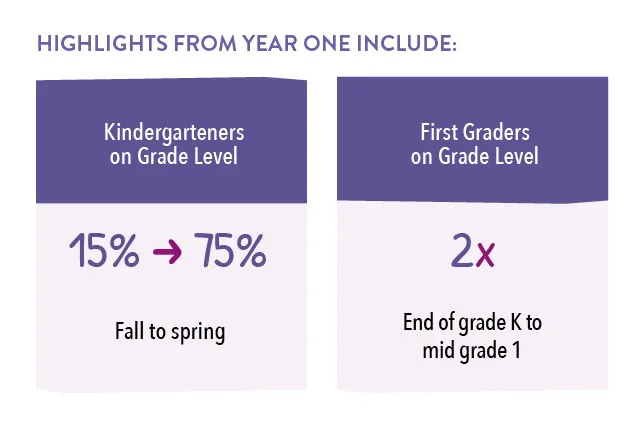
- 75% of kindergarten students were reading at or above grade level by spring, up from just 15% in the fall.
- Students scoring in the lowest performance band on word reading fluency dropped from nine students in fall to just two in spring.
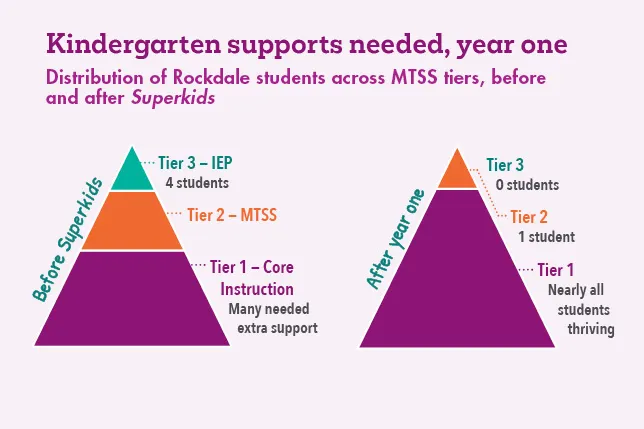
- Kindergarten IEP referrals dropped from four students to zero in a single year.
- The number of kindergarten students requiring intervention decreased dramatically from roughly 10 students to just one.
- Three students who entered from Spanish-only households with no English letter or sound knowledge were reading decodable texts, writing CVC words, and holding conversations in English—all by the spring of the same school year.
First-grade momentum
- The number of first graders reading proficiently and on grade level doubled between the end of kindergarten and the middle of first grade.
- Two first graders moved from the lowest performance band to grade level in a single semester, skipping the middle tier entirely.
Stronger Student Engagement and Confidence
The impact of Superkids extends far beyond assessment scores.
Teachers report stronger writing skills, increased confidence, and higher levels of engagement during literacy instruction. With students more engaged in instruction and feeling confident in their reading abilities, classrooms have also become calmer and more focused learning environments—giving teachers more time to support their students and students more opportunities to succeed.
"The engagement is incredible. The kids are so attached to the characters."
—Elizabeth Darlin, Principal
Rockdale School District 84
“The engagement is incredible,” Darlin explained. “The kids are so attached to the characters—they don’t have time to misbehave. They’re locked in and learning for the first two hours of the day.”
She continued. “Teachers keep saying they’re introducing skills they never would have taught before.”
Looking Ahead: Building Readers for the Long Run
For Darlin, the most exciting part is that she knows with Superkids, the best is yet to come.
For the first time, Rockdale will have students moving through multiple years of consistent, aligned literacy instruction in their early elementary years.
“It’s the only answer I’ve ever found to the questions about why kids aren’t learning to read,” Darlin exclaimed. “It feels like magic.”
After years of watching students struggle to read proficiently by the time they reached upper grades, she now sees something different emerging—students who are building the foundational skills they need from day one.
"I've never seen this much growth in one year from a program. It feels like magic."
—Elizabeth Darlin, Principal
Rockdale School District 84
“I’ve never seen this much growth in one year from a program. . . . I’m so excited to see what happens with multiple years under their belt.”
Share this case study with a colleague. Download a PDF that you can print and distribute.
You May Also Like